
(* Not actually decentralized)
Audio version:
Day One of ETHPrague
My home for the next four nights is a capsule in a constellation of plywood. A Prague hostel has converted bunk-bed rooms into a capsule hotel, filling the room with ten interlocking plywood pods. Each room has a toilet, a shower and two sinks. The rooms share a small kitchen that reeks of ramen spice packets.
This looks to be a clever move by the hostel: off season, over half the capsules are full and probably at twice the price that a single bunk bed would have gone for. The capsules are snug: an entrance with a short bench and a mirror and just enough room to stash my suitcase, as long as I have no intention of opening it. I need to step onto the bench to hoist up to the single mattress. My neighbor’s bed intersects like a backwards Tetris piece but our privacy is complete other than the shared spaces.
The following day I take a tram to Náměstí Republiky where people are already setting up their stands with cocktails and grilled sausages. The flashy Art Nouveau Municipal House is grafted onto a medieval wall, sitting uncomfortably next to the medieval Gothic tower at the boundary of Old Town and New Town. The Art Nouveau building built in 1912 on the site of the former Royal Court palace seems altogether too imposing for a crypto-conference. Two sculptures by Ladislav Šaloun flank the entrance: The Degradation of the People and The Resurrection of the People. Perhaps we are in the right place after all.
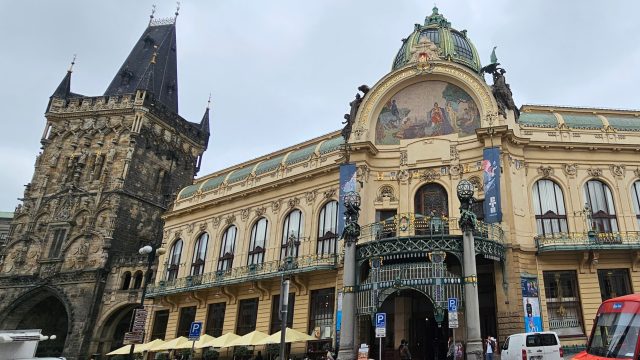
I join the t-shirted backpacked crowd and walk in.
We gather in the “hacker space”, Smetana Hall. Small tables fill the space under the domed stained-glass-and-steel ceiling. Mirrors sparkle with the light from gilded lamps. At the far end of the space is a stage with a massive organ of almost 5,000 pipes and two more sculptures. This is the actual room where Czechoslovak independence was proclaimed in 1918. After the opening speeches, the hackers will occupy this space.
I can’t help wishing that I was a hacker, dedicating the next seventy-two hours to creating something in this ornate hall.
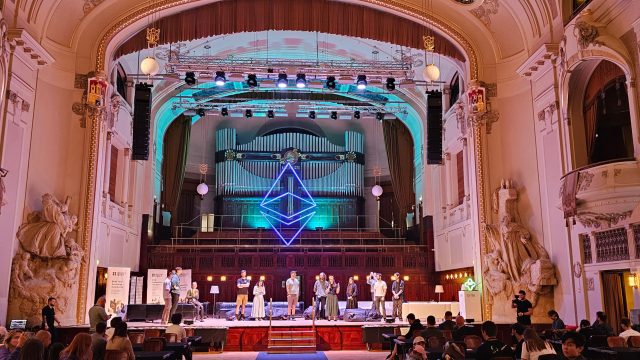
The first talk I attend is Emilien Duc of DeFiScan with the alarming title of How Many People Can Rug You?. He declares 2026 the year of preventable losses, with a common factor of off-chain failures. The problem is we treat “decentralized” as a buzzword, rather than a measurable metric. We need to look at who actually controls the protocol behind the scenes. This misuse of DeFi (Decentralized Finance) is a key theme throughout the conference. Duc’s point is that most DeFi today still depends on small groups of admins/keyholders behind the scenes. A quick search tells me that the industry standard is 4-of-7 or 5-of-9 multisig set up, which fits in with his average of seven admins per smart contract.
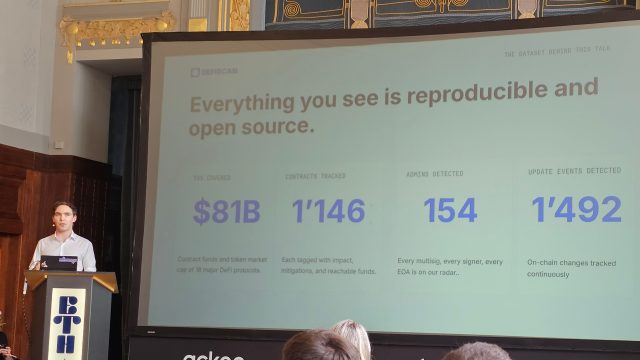
The answer to the question of how many people, by the way, is that it only takes four or five keyholders to rug you on most platforms. We’re mostly just trusting a handful of guys in group chat.
Next up is Sem with How we hacked TheDAO, again, relating the 2016 hack that broke DAO and led to an Ethereum fork. The story of how they decided to use the same exploit to recover funds, waiting to see if anyone else spotted them and got there first, was truly gripping.
The Crypto regulation and banks panel focuses on the intersection of cryptocurrency regulation and decentralized finance. Czech politician Ondřej Kovařík and Raiffeisenbank’s Product Owner for crypto-initiatives Tomáš Piškule speak to Ondrej Pilny, the head of Ecosystem Growth at Gnosis. They discuss the state of DeFi, MiCA regulation, stablecoins as a simple vehicle to transfer value, and the state of legislation. Both predict high crypto adoption in the banks in five years. Most exciting point: Agentic commerce will not happen without stable coins. If this is happening and people will start regularly using any kind of agents to carry out transactions on the internet for them, it will all happen on blockchain rails.
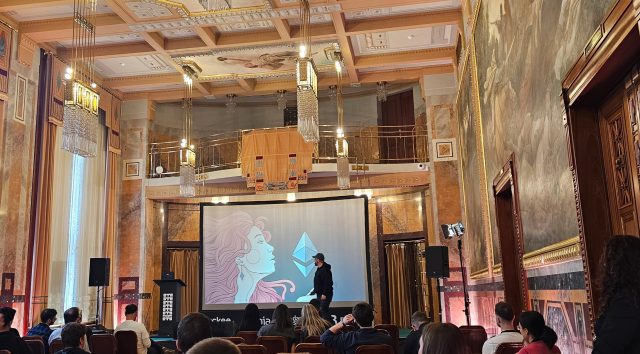
Unlocking AI Agentic UX with Google’s AP2 Standard and the x402 Protocol by Ben Greenberg, a senior dev/rel at Arbitrum, is surprisingly accessible: agents on the web are the new interface and we need to optimize for them. They are even more impatient than humans, who will quietly wait 3-4 seconds for a site to load, and they have difficulties paying. This is where the x402 protocol comes in.
I need a break. Ben is standing in the corridor and I join the conversation; we talk about travel and cruise ships and porn. I miss a talk on Optimizing Yield While Prioritizing Safety.
Stanislaw Šimek speaks on The Future of DeFi: From the Trenches and the Law, giving Web3 projects a clear decision point: are you tradfi and regulated or are you permissionless? Because, he warns, the current middle ground of pretending to be decentralized to avoid regulation will not survive.
If the cocktails were less expensive, I would be getting a drink every time someone told us that most DeFi isn’t.
Instead I sneak out to have some lunch at Náměstí Republiky which, I notice, has cheaper cocktails available in a variety of stalls. I dismiss the idea of running out of Municipal House every time someone complains about the mis-use of DeFi and settle for some food.
I return to the fray for editor Macauley Peterson on When tokens meet reality: why crypto needs disclosure standards. Peterson tells us about the original innovation of trading securities on Wall Street, and twenty-five years later, those traders wrote a constitution and formed what would become the New York Stock Exchange. The Securities Exchange Act, the Chicago Board of Trade and the Futures Act show that same trend: members of a community instituting formal trading strategies and contract standardization. And yet, now, the people who understand the technology are hanging back. The question is whether they will step in to create industry-led standards or continue to allow people who don’t understand it to create regulation. I may not be in that group of those who understand the technology but I am hugely motivated by the talks on this first day, loving that feeling that every person can make a difference.
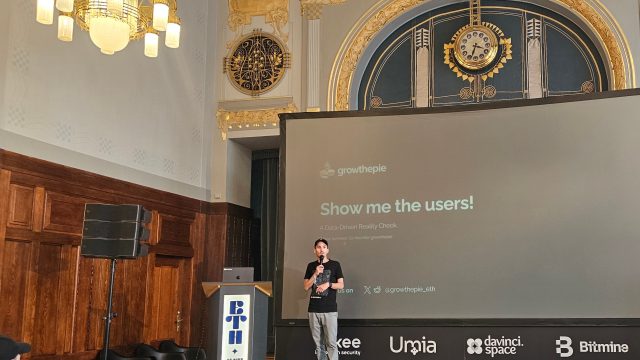
Tobias Schreier’s talk is a battle cry: Show Me the Users! A Data-Driven Reality Check. He shows us chewy stats from growthepie that show that Ethereum and L2 usage is still heavily dominated by basic financial speculation. The most startling stat: 75% of Polygon fees are coming from users interacting with Polymarket? What happens when they move? But growthepie also shows us real-world traction, for example a shift towards non-USD stablecoins such as EuroC and the Swiss CHF-based Frankencoin that you can use to pay for your cheap groceries at SPAR.
By now, the planned presentations are diverging quite a bit from the schedule, especially for those of us changing rooms every 25 minutes, and I dash in late for Monetizing Crazy Times with Prediction Markets by Swiss lawyer Anne-Grace Kleczewski. She convinces me with a single quote: “Greatly designed beliefs certainly contribute to crowd intelligence, but poorly designed ones are merely depicting attempts at making some quick money.”
Between the three tracks of talks, people gather out on the balcony, standing in the sunshine overlooking the tourists. The conversations swirl around me. “I’m not with them any more but I’m still in Portugal, co-living there, looking for opportunities.” “People are saying the old location was better but I like this. It feels like the real Prague.” “Yeah, I’m back in Berlin, got a one-year-old daughter, so that’s grounding me.” “I tell them that they all need x402 but to be honest, I’m not that technical.” “I got a gun. Accidentally. It’s not a bug, it’s a feature.”
I go back inside.
I get back into synch with Who Owns Attention in a Decentralised Future? Toward Value-Aligned Recommendation Systems by Alexander Trauth-Goik, who explains algorithmic curation in surveillance capitalism and that we are being tricked into believing that invasion of our privacy and the fracturing of our attention is a necessary price to taking part in social media. “Do we want recommendation algorithms and technology in general to hijack and undermine our psychological vulnerabilities, or to empower and elevate the better angels of our nature?” Recommendation algorithms could be giving us information that better serve our long-term interests and goals.
Veronika Civínová gives us a surprising angle with Practical challenges of EU laws: from climate to crypto. Civínová argues that while the media frames crypto and climate regulations as being in direct conflict, crypto actually fits beautifully into the broader definition of “sustainability.” By looking past just environmental impact to include social and corporate governance pillars (like community focus and superior business conduct), crypto can prove it’s sustainable, provided it doesn’t “significantly harm” the environment.
It’s only ten past six but I feel like I’ve already experienced three days of conference into one. I wander aimlessly around Municipal House, sipping water and looking up at the ornate ceilings and dangling chandeliers. Then I walk home, stopping for a hearty meal at a quiet restaurant on the way. One beer at the hostel bar and I have to admit that I’m ready for bed. I snuggle into my plywood pod, head full of ideas.
My neighbor enters his pod, slamming the door behind him, shaking the entire unit of four. I consider banging on the wall, annoying everyone with my hiss of “can you keep it down???” but while I’m still considering how to respond in a way that doesn’t make things worse, my eyes flutter shut and I fall asleep.
This series was supported through the generosity of the Peacock Foundation.
Tomorrow: I am reminded once again that my greatest vulnerability isn’t code. It’s me.